Hack Squat vs Leg Press: Which Is Better for Leg Growth?
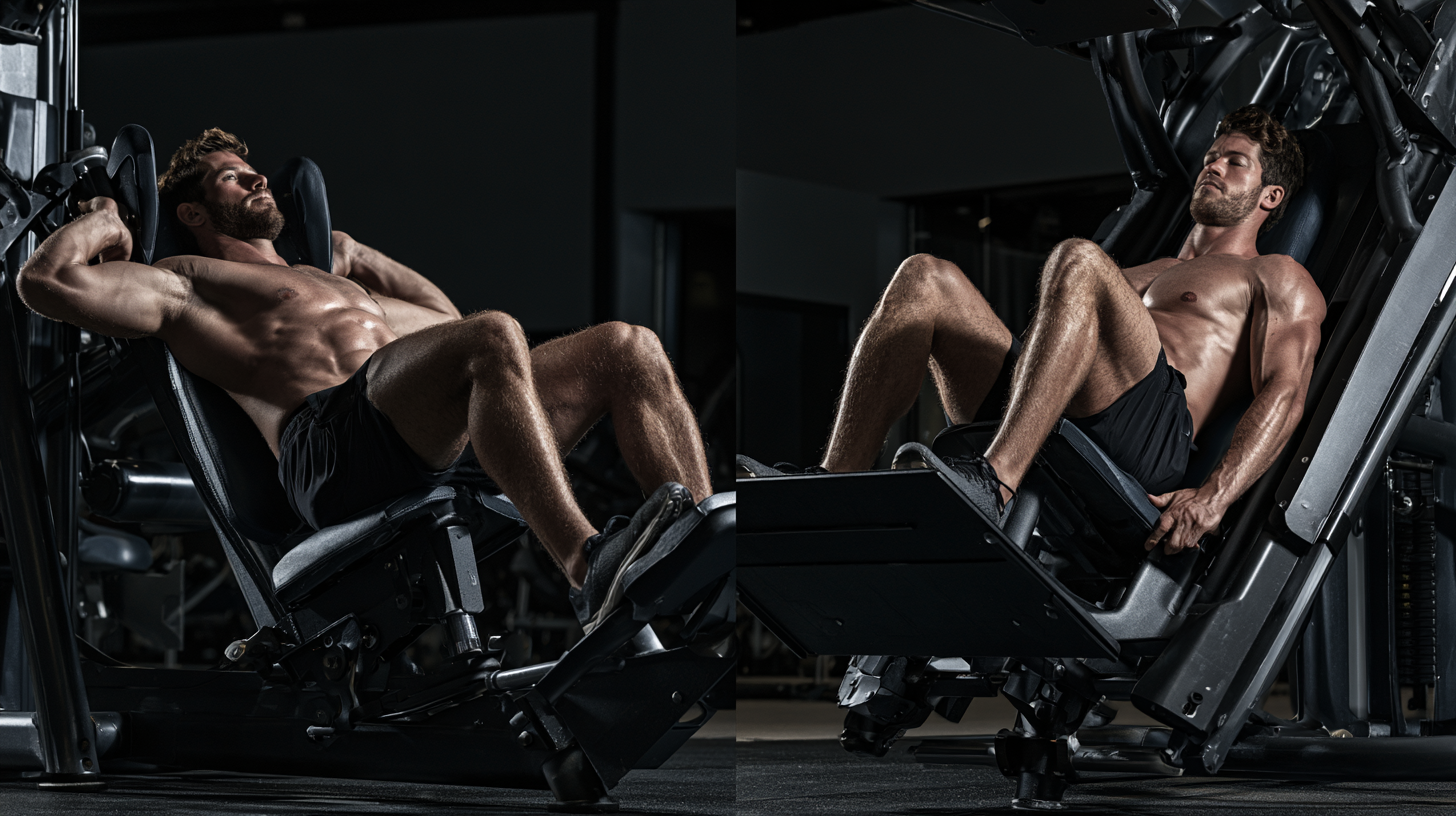
Note: If you are viewing exercise videos on a mobile device, please switch to horizontal view for the best experience.
The hack squat vs leg press debate often comes down to a deceptively simple question: which machine builds bigger legs?
Both exercises allow you to train your quadriceps hard without having to balance a barbell. Both can be loaded progressively and taken close to muscular failure. However, the position of your body and the path followed by the machine create a noticeably different training experience.
For most people, the hack squat offers a more squat-like movement with a particularly strong quadriceps emphasis. The leg press provides more support, usually allows heavier loading and gives you greater freedom to adjust your foot position.
That does not make one universally better. The best choice depends on what you want to develop, which machine fits your body and which one you can perform through a useful range of motion without pain.
Hack Squat vs Leg Press at a Glance
| Factor | Hack squat | Leg press |
|---|---|---|
| Main muscles | Quadriceps and glutes | Quadriceps, glutes and adductors |
| Body position | Back supported with weight carried through the shoulders | Seated or reclined with the back against a pad |
| Movement | Body moves with the sled | Footplate or seat moves away from the body |
| Quad emphasis | Usually very high | High, depending on setup and foot position |
| Stability | High | Very high |
| Typical loading | Moderate to heavy | Often allows heavier absolute loads |
| Foot-position options | Some adjustment | Usually greater adjustment |
| Best suited to | Quad-focused, squat-like training | Supported leg volume and training close to failure |
What Is the Main Difference?
During a machine hack squat, your shoulders sit underneath padded supports and your back remains against a moving pad. As you bend your knees, your body travels down the machine’s fixed track.
This resembles a squat more closely than a leg press does, although the machine removes much of the balance requirement. The relatively upright position and forward movement of the knees can create a demanding exercise for the quadriceps.
On a leg press, your torso remains supported while your legs push either a footplate or a movable seat away. You still extend your knees and hips, but you do so from a seated or reclined position.
The additional support makes the leg press easy to learn and allows you to concentrate on pushing with your legs. It also makes high-repetition sets, drop sets and training close to failure more manageable.
Muscles Worked
Both exercises primarily train the quadriceps, which extend the knee as you push out of the bottom position. The gluteus maximus and adductors also contribute through hip extension.
The hack squat generally feels more quad-dominant because it encourages substantial knee flexion while keeping the torso supported. Placing the feet slightly lower on the platform can increase knee travel further, although going lower is not automatically better if your heels lift or your knees become uncomfortable.
The leg press can also provide a strong quadriceps stimulus. A relatively low foot position normally increases the amount of knee flexion, while a higher position tends to involve more movement at the hips.
These effects should not be exaggerated. Changing foot position does not completely isolate a particular section of your legs, and individual anatomy and machine design influence the result.
If you want to develop your thighs more broadly, our guide to quadriceps-strengthening exercises provides several additional options.
Which Is Better for Building Your Quadriceps?
The hack squat probably has a slight practical advantage when the specific goal is quad-focused training.
It provides a stable squat pattern, allows plenty of knee flexion and makes it difficult to shift the work away from your thighs by leaning forwards. Many lifters find that their quadriceps reach failure before their breathing, grip or lower back becomes the limiting factor.
However, that does not establish that hack squats always produce greater muscle growth than leg presses. Direct long-term research comparing hypertrophy from the two machines is limited. Muscle-activation readings alone cannot tell us which exercise will build more muscle over several months.
A well-performed leg press through a comfortable range of motion can still provide substantial quad growth. Research involving resistance-trained participants has found quadriceps growth following leg press training across different knee-flexion ranges, with no clear hypertrophy advantage from simply using the greatest possible depth.
The more useful question is therefore: which machine allows you to load your quadriceps consistently, control the weight and progress without other factors ending the set first?
Which Is Better for Overall Leg Development?
The leg press may have the edge for accumulating overall lower-body training volume.
Its large platform normally provides more freedom to experiment with stance width and foot height. It is also suitable for single-leg work, provided the machine can be adjusted safely.
Because your torso is supported, you can often perform more repetitions after other demanding exercises. This makes the leg press particularly useful towards the middle or end of a leg session.
Neither movement should be treated as a complete leg workout, though. Knee flexion and hip extension occur together, so the hamstrings are not trained as effectively as they would be with leg curls or a dedicated hip-hinge exercise. Calf work may also need to be added separately.
Which Is Better for Your Knees?
Neither machine is automatically good or bad for the knees.
Deeper knee flexion generally increases the demand placed on the knee extensors and surrounding joint structures. That is not inherently dangerous for a healthy, suitably prepared lifter, but depth and load need to match individual mobility and tolerance.
Research comparing squat and leg-press variations has found that stance and technique can alter forces around the knee. This supports adjusting the exercise to the individual rather than relying on a universal “safe” foot position.
If hack squats cause discomfort, try reducing the load, altering your foot position and working within a pain-free range. If the leg press causes discomfort, check that you are not lowering the sled so far that your pelvis rolls away from the backrest.
Persistent or sharp pain is a reason to stop and seek qualified medical or physiotherapy advice, not something to train through in pursuit of greater depth.
If discomfort or reduced strength is limiting your training, these quad-strengthening exercises for knee pain provide some gentler starting options.
Which Is Better for Your Lower Back?
The leg press removes the need to support a weight across your shoulders, which may make it feel more comfortable when your lower back is fatigued. However, this does not mean the spine is completely unloaded.
At the bottom of a deep leg press, some lifters allow their pelvis to rotate and their lower back to round away from the pad. Heavy loading in that position can be uncomfortable.
Keep your hips and lower back in contact with the pad. Lower the weight only as far as you can while maintaining that position.
The hack squat supports your back but transfers load through the shoulder pads. It may involve more trunk activity than the leg press, although considerably less balance is required than during a free-weight squat.
Anyone with an existing back problem should choose exercises with guidance from an appropriately qualified professional rather than assuming one machine is safe for every condition.
Is the Leg Press Better for Beginners?
The leg press is normally the easiest of the two exercises to learn.
The supported position lets a beginner practise extending the knees and hips without worrying about balance. The safety stops should still be set correctly, and beginners should avoid loading the machine with plates simply because it allows them to move more weight than a squat.
A hack squat is also accessible, but the fixed path may not suit everyone immediately. People with limited ankle mobility or long femurs sometimes need to experiment with their foot position to find a comfortable movement.
Machine design matters here. Feeling awkward on one particular hack squat does not necessarily mean every hack squat will be unsuitable.
Can You Do Hack Squats and Leg Presses in the Same Workout?
Yes, although you do not have to use both.
A quad-focused workout might begin with hack squats while you are fresh, followed by leg presses for additional controlled volume:
- Hack squat: 3–4 working sets of 6–10 repetitions
- Leg press: 2–4 working sets of 10–15 repetitions
- Leg curl: 3 working sets of 8–15 repetitions
- Calf raise: 3–4 working sets of 10–20 repetitions
Another option is to alternate them between workouts. You could use hack squats as your main machine movement during one training block and leg presses during the next.
Using both only makes sense if you can recover from the combined workload. Adding more exercises does not guarantee more growth once the quality of your sets begins to fall.
Common Technique Mistakes
Loading too much weight
Leg presses are particularly vulnerable to ego lifting. Moving a heavily loaded sled through a few centimetres is not the same as performing controlled repetitions through a repeatable range.
Bouncing out of the bottom
Allowing the machine to rebound out of its lowest position reduces control and can expose the joints to forces you are not prepared to manage.
Locking the knees aggressively
Extend your legs under control without forcefully snapping the knees into lockout.
Allowing the knees to collapse inwards
Your knees should generally follow the direction of your toes. Reduce the weight if you cannot maintain control as fatigue develops.
Changing depth on every repetition
Use a range you can reproduce. Progressive overload becomes difficult to measure if every additional plate is accompanied by progressively shorter repetitions.
Hack Squat vs Leg Press: The Verdict
Choose the hack squat when your main priority is a stable, squat-like exercise that places a strong emphasis on the quadriceps.
Choose the leg press when you want maximum support, flexible foot placement and an exercise that makes it easier to accumulate additional lower-body volume.
For many people, the best answer is not to declare one machine the winner. Use the one that fits your body, train it consistently and record your repetitions, load and range of motion. You can then introduce the other machine when it provides something your existing programme is missing.
The hack squat may have a small practical advantage for focused quad training, while the leg press offers greater versatility. Neither can compensate for shallow, uncontrolled repetitions or a programme that never progresses.
You can also use our interactive muscle exercise guide to find complementary exercises for the glutes, hamstrings and calves.
Frequently Asked Questions
Is the hack squat harder than the leg press?
Most people can move more weight on a leg press because the body is more fully supported and the machine provides different leverage. Loads cannot be compared directly because sled angles, friction and machine designs differ.
Can the leg press replace hack squats?
Yes. If your gym does not have a hack squat—or the available machine does not suit your build—the leg press can still provide an effective quadriceps workout.
Are hack squats better than normal squats?
Hack squats provide more stability and may allow you to train your quadriceps closer to failure. Free-weight squats require more balance and trunk involvement. The better exercise depends on the adaptation you want.
How deep should you go?
Use the deepest range you can control without pain, your heels lifting or your pelvis losing its stable position. Greater depth is not useful when it causes your technique to break down.
Should hack squats or leg presses come first?
Place whichever exercise matters most to your goal first. For quad-focused training, that may be the hack squat. If you are prioritising leg-press strength or the leg press feels considerably better, perform it first instead.
Sources
- Escamilla RF et al. “Effects of technique variations on knee biomechanics during the squat and leg press.” Medicine & Science in Sports & Exercise.
- Clark DR, Lambert MI and Hunter AM. “Trunk Muscle Activation in the Back and Hack Squat at the Same Relative Loads.” Journal of Strength and Conditioning Research.
- Kassiano W et al. “Knee flexion range of motion does not influence muscle hypertrophy of the quadriceps femoris during leg press training in resistance-trained individuals.” Journal of Sports Sciences.