How to Choose Exercises by Muscle Group
Note: If you are viewing exercise videos on a mobile device, please switch to horizontal view for the best experience.
Walk into a gym without a plan and it is easy to choose exercises based on whatever equipment happens to be available. You might complete a few chest presses, add some curls, move on to the leg press and finish with abdominal exercises. You have worked hard, but have you trained the areas you intended to train?
Organising exercises by muscle group gives a workout more structure. It helps you understand why an exercise has been included, identify areas that may be neglected and avoid filling a session with several movements that all perform essentially the same job.
This does not mean you need an advanced knowledge of anatomy before lifting a weight. A basic understanding of the major muscle groups, combined with the ability to recognise the primary and supporting muscles involved in an exercise, is enough to make more informed decisions.
Start With the Movement, Not Just the Muscle
Although workouts are frequently organised by body part, muscles rarely work in isolation. Most movements require several areas of the body to work together.
The bench press is generally regarded as a chest exercise, but the triceps and front of the shoulders also contribute. A pull-up primarily trains the back, while also involving the biceps, forearms and muscles around the shoulders. Squats recruit the quadriceps, hamstrings and glutes, with the core helping to keep the body stable.
This distinction between primary and secondary muscles matters when planning a workout. Completing several pressing exercises for the chest may also place considerable demand on the triceps. Adding a large number of isolated triceps exercises afterwards may not always be necessary, particularly for a beginner.
Before choosing an exercise, consider three questions:
- Which muscle is the exercise primarily intended to train?
- Which other muscles assist with the movement?
- Does the exercise duplicate something already included in the workout?
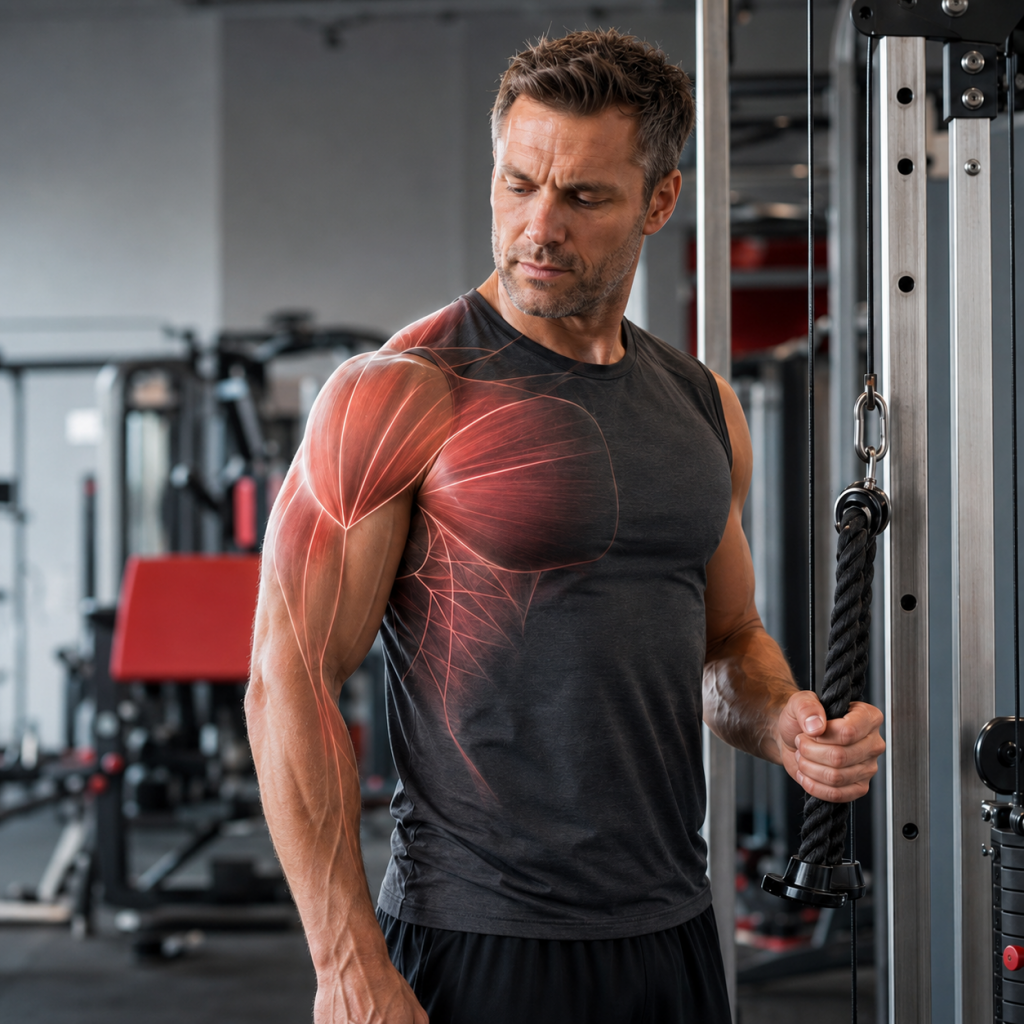
You can use the RMF interactive muscle map and exercise finder to select one or more areas of the body and explore exercises that target them.
Understand the Major Muscle Groups
Most strength-training programmes are built around several broad areas: the chest, back, shoulders, arms, core and lower body. Each contains individual muscles with different functions.
The chest is dominated by the pectoralis major and is commonly trained through pressing and fly movements. The back includes the latissimus dorsi, trapezius, rhomboids and several smaller muscles involved in pulling, posture and shoulder movement.
The shoulders are more complex than they initially appear. The deltoids have front, side and rear portions, while muscles including the infraspinatus support shoulder movement and stability. A programme filled with pressing exercises may train the front deltoids heavily while giving relatively little attention to the rear shoulder.
The lower body includes the quadriceps, hamstrings, glutes, calves and muscles surrounding the hips. Squats, lunges and deadlift variations can train several of these areas together, while leg curls, calf raises and other isolation exercises provide a more concentrated stimulus.
The arms contain more than the biceps and triceps. The brachioradialis and numerous finger and wrist muscles contribute to forearm and grip strength. These smaller areas may already receive considerable work from rows, pull-ups, curls and loaded carries.
Compound or Isolation Exercises?
Compound exercises involve movement at more than one joint and usually recruit several muscle groups. Examples include squats, presses, rows, pull-ups and deadlift variations. They are an efficient way to train a large amount of muscle within a limited session.
Isolation exercises place greater emphasis on a particular muscle or movement. Biceps curls, triceps extensions, lateral raises, leg curls and calf raises are familiar examples.
The choice does not need to be either compound or isolation. Many effective workouts use compound movements to provide the foundation of the session, followed by selected isolation exercises for muscles that require more attention.
A lower-body workout, for example, might begin with a squat variation before moving to a hip-hinge exercise, leg curls and calf raises. An upper-body session could combine a chest press, row and shoulder press with lateral raises and arm exercises.
The appropriate balance depends on your goals and experience. Someone training for general strength with limited time may favour compound movements. A bodybuilder seeking balanced muscular development is more likely to use a wider selection of isolation exercises.
Choosing Muscles to Train Together
Muscle groups are often combined according to the way they contribute to similar movements.
A chest and triceps workout is popular because pressing exercises train both areas. Back and biceps are commonly paired because pulling movements involve the biceps. Quadriceps, hamstrings and glutes can be brought together in a broader lower-body session.
A push, pull and legs routine applies the same principle across several workouts. Push sessions generally include the chest, shoulders and triceps. Pull sessions cover the back, biceps and forearms, while leg sessions concentrate on the quadriceps, hamstrings, glutes and calves.
These combinations are convenient, but they are not compulsory. Someone training twice a week may find full-body workouts more practical, while a person training four times might divide sessions between the upper and lower body.
The best arrangement is one that provides enough training without repeatedly exhausting the same muscles before they have recovered.
Look for Gaps and Unnecessary Repetition
A workout may contain plenty of exercises and still be poorly balanced. Three different chest presses, for example, might offer less variety than a press combined with a pulling movement and an exercise for the rear shoulders.
When reviewing a workout, look at the movements as well as the muscle names. Does it contain both pushing and pulling? Are the front and back of the body represented? Does the lower-body training include knee-dominant and hip-dominant movements? Are smaller supporting muscles being ignored?
It is also worth considering how the programme fits together across the entire week. A muscle that appears to be missing from one session may already receive sufficient work elsewhere.
Adding exercises should solve an identifiable gap. More movements do not automatically produce a better workout, particularly if the additional volume affects technique or recovery.
Match Exercises to Your Circumstances
An exercise can be effective in theory and still be unsuitable for a particular person. Equipment, experience, mobility, previous injuries and confidence all influence what can be performed safely and consistently.
A barbell squat is not the only way to train the quadriceps and glutes. Depending on the individual, a goblet squat, split squat, leg press or other variation may be more appropriate. Pull-ups can be replaced or supported by assisted pull-ups, pulldowns or rows.
Home workouts require the same kind of flexibility. Dumbbells, resistance bands and bodyweight movements can provide alternatives when machines and barbells are unavailable.
Rather than searching for the single “best” exercise, look for an effective movement that targets the intended muscles, suits the available equipment and can be performed with control.
Building a Balanced Workout
A useful starting point is to choose a small number of movements that cover the main areas you intend to train. Once those are in place, add isolation work only where it serves a clear purpose.
For a full-body session, that could include:
- A squat or lunge movement
- A hip-dominant movement
- An upper-body press
- An upper-body pull
- An appropriate core exercise
This is a starting framework rather than a universal prescription. Exercise selection, training volume and frequency should be adjusted to the individual.
The RMF interactive muscle map can help you explore the relationship between different muscles and exercises. Select the areas you want to train, compare the available movements and use the results to make more deliberate choices.
Understanding which muscles an exercise targets will not remove every element of trial and error. It will, however, make it easier to build workouts with a clear purpose—and recognise when an exercise has earned its place.